
Soils with high reactivity — The clay soils in Melbourne are one of the most reactive types of soil in Australia. These soils swell significantly when they are wet and shrink dramatically during hot months and dry periods. As a result of the swelling and shrinking of the soil at your house, there is continual movement of the ground beneath your home, which accumulates over time and can result in structural damage.
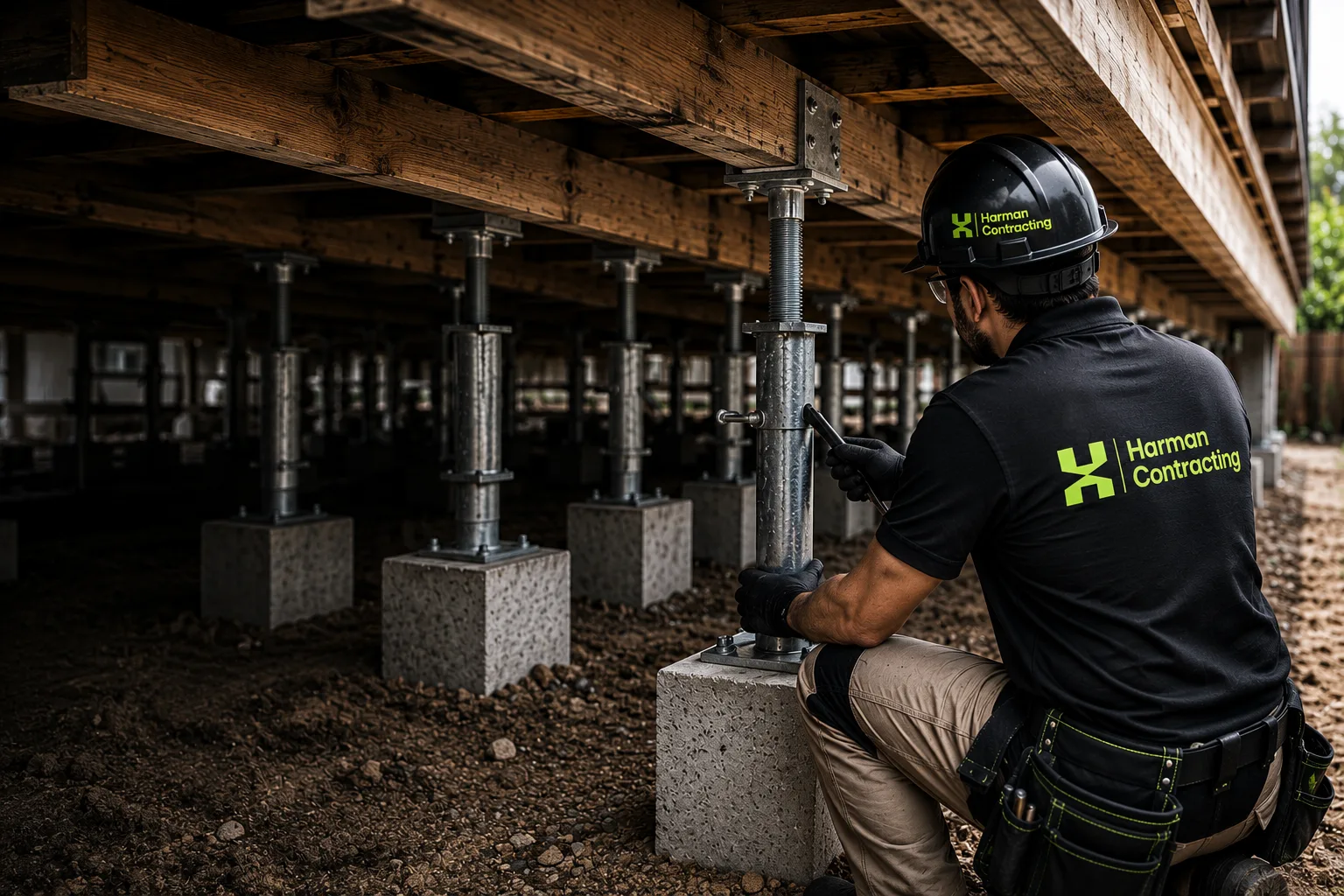
Deteriorating timber foundations/stumps — Most older Melbourne homes were built on timber foundations, and over time, these timber foundations deteriorate (rot), settle out of level or lean because of the significant differences in weight at the various areas of the house. This difference in settlement puts unmatched stress and strain on your walls, floors and the entire home; eventually, cracking will occur as the timber foundation/stump deteriorates.
Leaking pipes
— The soil that surrounds your home can become saturated and soft over a period of time due to leaking pipes, whether it’s from a broken stormwater pipe, a leaking hot water service, or a slow plumbing leak underneath your house. The soil loses its ability to support weight because it has been saturated with water, therefore the section of the foundation above the saturated soil slowly begins to settle, which produces cracks in the wall above.
Poor drainage
— Water that accumulates against the side of your home or runs toward your foundation as a result of inadequate drainage can also result in similar problems. Persistent moisture against your footings can cause progressive settlement and cracking over time as softens the soil around your footings.
Inadequate original footings
— Many homes in Melbourne, particularly those built before 1980, were built on footings that were not designed to accommodate the reactive clay conditions of Melbourne. Therefore, as the footing loses its battle against the soil over the years, the house above the footing will begin to show the signs of failure.
Neighbouring construction — When excavation or construction is taking place on a neighbouring property, it can disrupt the soil and cause foundation movement in your home, sometimes very quickly. If you have seen cracks in your walls or floors that started or increased in severity after construction began nextdoor, this may be a cause that should be looked into further.
Diagonal cracks in door and window corners – The presence of diagonal cracks radiating from corners of doors and windows on a wall is one of the most prevalent signs of foundation movement in a residential property. Foundation settlement and movement will produce stress that is most heavily concentrated at the weakest areas within a wall’s structure, the openings. Because all foundations on a building are a solid mass, the openings therefore are the weak spots and will produce diagonal cracks out of the corners when there is settlement.
Stair step cracks in brickwork – Stair step cracks that occur along the mortar joints of exterior and/or interior brickwork are an indication of differential foundation settlement. Differential foundation settlement occurs when one section of a building’s foundation has experienced more “downward” movement than does the adjacent portion of the foundation. These types of stair step cracks should be evaluated by a qualified professional.
Horizontal cracks – Large horizontal cracks in brick or rendered walls can be an indication of lateral soil pressure against the structure or foundation member experiencing structural bending. Large horizontal cracks are typically more serious than diagonal or vertical cracks and should be evaluated immediately.
Vertical Cracks – In most cases, vertical cracks are caused by normal changes in temperature and humidity which cause the walls and ceilings of a house to expand and contract. If the size, number, or progression of the vertical cracks is increasing, they need to be examined for further analysis.
Cracks along wall and ceiling junctions – Creeping or cracking of the wall and ceiling intersection can indicate a difference between the growth and shrinking of the two structures and should be investigated. This should be done if the crack appeared recently or is getting larger.
Hairline Cracks in Plasterwork or Render – Fine line type cracks are common in older plasterwork based on normal expansion and contraction of plaster or render materials due to temperature fluctuations or normal drying out of the material. In most instances these cracks are only cosmetic; however, if the number of cracks has increased, they are getting larger, or if there is other evidence of movement, a professional should be called for further analysis before determining how serious the situation is.
Single, isolated hairline cracks in an otherwise stable older home are often cosmetic. However, cracks that are diagonal, wide, actively growing, or appearing in multiple rooms simultaneously are a stronger indication that foundation movement may be involved and professional assessment is recommended.
Most of the time, external wall cracking is a more serious problem than internal cracking; this is because external walls are structural members and are load-bearing components of a home. Damage to these elements affects the whole house and its structural integrity.
Furthermore, external wall cracks can cause water to enter through the wall system, making the wall deteriorate at an increased rate, creating problems with moisture and resulting in further damage as time passes. All external stair-step cracks through brick mortar joints, diagonal cracks at the sills of windows and doors, and horizontal cracks through rendered wall systems should be evaluated by a professional and repaired correctly—not just patched up and painted over.
Most of the time, having cracks in the external walls of your home is a more serious issue than having cracks inside. The reason for this is that your external walls are structural components of your home, designed to carry all of the weight of your home, and if there is damage to them, it can create problems with the overall structural integrity of your entire house.
The second problem with external cracks is that they provide an entry point for water to enter the wall structure and cause accelerated deterioration, promote dampness, and ultimately cause other damage over time. All types of external wall cracks should be evaluated by a professional and repaired properly, rather than just repaired and painted.
Step 1 — On-Site Inspection – We come out to your home and carry out a thorough assessment. We look at the cracks in detail, including their type, location, direction, width, and whether they appear to be active or stable. We also inspect beneath the house to assess the condition of the foundation and stumps. This gives us a complete picture of what is causing the cracking, not just what it looks like on the surface.
Step 2 — Foundation Repair First – If the cracking is caused by foundation movement, which is the case in the vast majority of properties we assess, we address the foundation first. Depending on what the inspection reveals, this may involve underpinning, reblocking, restumping, or targeted foundation repairs. There is little value in repairing wall cracks until the movement causing them has been stopped.
Step 3 — Wall Crack Repairs – Once the foundation is stable and the building has settled, we carry out the crack repairs. This may involve raking out and repointing mortar joints, filling and re-rendering cracked render, repairing plasterwork, or undertaking more extensive structural repairs where the cracking has caused significant damage to the wall.
Step 4 — Advice on Prevention – We provide practical guidance to help reduce the risk of future cracking. This includes improving drainage around the foundation, managing trees located close to the house, maintaining gutters and downpipes in good working order, and understanding the early warning signs of foundation movement to monitor in the future.
The pricing is contingent upon 2 factors: the type/size of the crack repair that needs to be done and whether there is also any foundation work that needs to be done first. In general, a purely cosmetic crack repair on a stable wall is relatively easy and affordable to accomplish. The pricing for crack repairs that are needed after underpinning or foundation work is more complex since the entire scope of the foundation repair and crack repair must be included in a total price.
The first step is to schedule an on-site, no-obligation quote. We will visit your home and assess both the cracks and your foundation’s current condition to give you a complete and itemized price for the work that needs to be done, so you know exactly how much you will need to pay before any repair work begins.
Doing so also allows us to recommend the most cost-effective, appropriate solution for resolving the root cause of cracking. Therefore, if reblocking will resolve the underlying cause for the cracking, we will let you know that. We will not recommend performing more work on your home than what is truly necessary.