
Balwyn is one of Melbourne’s most established inner-eastern suburbs, known for its attractive period homes, mature streetscapes, and high-value residential properties. While these characteristics contribute to the suburb’s appeal, they also create a unique set of foundation challenges that homeowners need to be aware of.
The suburb is situated within Melbourne’s inner-eastern clay belt, where highly reactive soils expand during wet conditions and contract during dry periods. This ongoing cycle of soil movement places continual stress on building foundations. Over time, that movement can lead to cracking, settlement, uneven floors, and other signs of structural movement.
Several factors make foundation movement a particularly important consideration for Balwyn homeowners:
An Older Housing Stock Sitting on Ageing Foundations
Much of Balwyn’s residential development occurred between the 1920s and 1960s. While these homes were generally built to a high standard, many now sit on foundations that are between 60 and 100 years old. Traditional footing systems, including shallow strip footings and timber stumps, were not specifically designed to accommodate decades of reactive soil movement, making foundation repairs increasingly common as these properties age.
Large, Established Trees
Mature street trees and established gardens are a defining feature of Balwyn. However, large trees can extract significant amounts of moisture from surrounding soils, particularly during extended dry periods. This localised soil drying can contribute to foundation settlement and structural movement, making tree root activity a common factor in foundation issues throughout the suburb.
The Value of the Properties
In a suburb where homes represent a significant investment, foundation issues can have a substantial impact on both structural performance and property value. Addressing foundation problems correctly not only protects the integrity of the building but can also help maintain market value and avoid complications during future property transactions.
Many Balwyn homeowners have lived in their properties for years and, in some cases, decades. Over time, it can be easy to dismiss small cracks, sticking doors, or uneven floors as normal characteristics of an older home. While that may sometimes be the case, these signs can also indicate underlying foundation movement that warrants professional assessment.
Here are some common warning signs to watch for in a Balwyn home:
A significant proportion of the foundation repair work we undertake in Balwyn involves the suburb’s established period homes, including Interwar bungalows, post-war brick residences, Federation-era properties, and other character homes that contribute to the area’s distinctive streetscape and long-term value.
These properties require a careful and considered approach. Original plasterwork, hardwood flooring, decorative brickwork, timber detailing, and other period features must be protected throughout the repair process. Our objective is to stabilise the structure beneath the home while preserving the character and appearance that make these properties unique.
Effective foundation repairs should resolve the underlying structural issues without compromising the building’s original features. When completed correctly, the home should retain its existing appearance while benefiting from a more stable and reliable foundation system.
We work on a wide range of period home styles throughout Balwyn, including brick veneer, double-brick, weatherboard, and mixed-construction properties. Our experience with the construction methods and foundation systems used across different eras allows us to tailor repair solutions to the specific requirements of each home.
Tree root activity is worth its own mention in Balwyn because it’s such a significant and recurring contributor to foundation problems across the suburb. The mature European trees that line Balwyn’s streets and fill its gardens are one of the suburb’s most valued characteristics but they’re also drawing moisture from the soil in a way that directly affects the foundations of the homes around them.
When a large tree draws moisture from the soil beneath a nearby foundation, the soil shrinks and the ground subsides often in a very localised area directly beneath or near the tree. The result is typically cracking in the walls closest to the tree, sometimes appearing quite quickly during a dry summer when the tree is drawing hardest.
Removing the tree doesn’t always solve the problem immediately and in some cases can make things temporarily worse, as the soil rehydrates and expands in the absence of the tree’s moisture demand, causing the foundation to move in the opposite direction. The right approach depends on the specific conditions of the site, and it’s one of the things we assess carefully during our inspection of Balwyn properties.
Underpinning
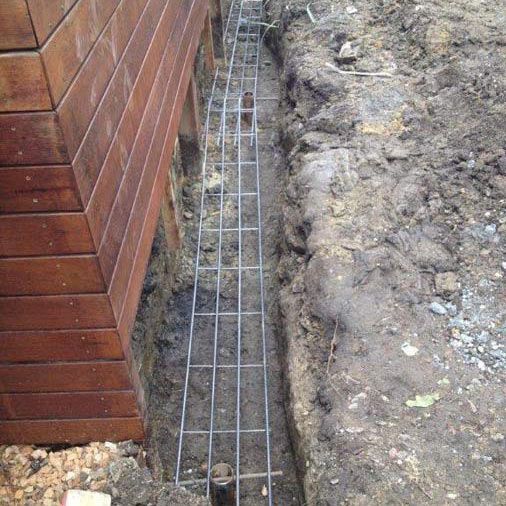
Underpinning is one of the most reliable and long-term solutions for foundation movement in Balwyn’s period homes. Reinforced concrete pier footings are installed alongside or beneath the existing foundations, extending through reactive soil layers and into stable, load-bearing ground. This helps prevent further movement and restores structural stability to the building.
Reblocking & Restumping
Many older Balwyn homes are supported by timber stumps that can deteriorate or settle over time. Reblocking and restumping involve replacing affected supports with new concrete or steel stumps to improve structural support, restore floor levels, and reduce ongoing movement. Each stump is individually inspected to ensure that only the supports requiring replacement are included in the repair scope.
Screw Piling
Where conventional underpinning is less practical due to restricted access or challenging soil conditions, screw piling provides an efficient and minimally disruptive alternative. High-strength steel piles are installed deep into stable load-bearing soil with limited excavation, making this method well suited to many established Balwyn properties.
Micropiling
For sites with limited access, restricted subfloor clearance, or areas where conventional foundation equipment cannot operate, micropiling offers a highly effective deep foundation solution. Using specialised compact equipment, we can stabilise foundations in locations that are difficult to access using traditional methods.
Crack Repairs
Lasting crack repairs begin with addressing the underlying cause of the movement. Once the foundation has been stabilised and the structure has settled, cracks can be professionally repaired to provide a durable and long-term result. Repairing cracks without first resolving foundation movement is rarely an effective long-term solution.
Foundation Repairs
Not every foundation problem requires extensive underpinning. Where movement is localised to a specific area of the property, targeted foundation repairs can often provide the most practical and cost-effective solution. Every Balwyn property is individually assessed to determine the most appropriate repair strategy based on the actual site conditions.
Our team covers Balwyn and all surrounding inner-eastern suburbs including:
Balwyn, Balwyn North, Kew, Kew East, Camberwell, Canterbury, Surrey Hills, Box Hill, Box Hill South, Mont Albert, Mont Albert North, Deepdene, Hawthorn, Hawthorn East, Boroondara, Nunawading, Blackburn, and the broader Boroondara and Whitehorse council areas.
If your suburb isn’t listed here, give us a call — we cover a wide area across Melbourne’s inner east and the chances are we service your location.
Balwyn homeowners typically value quality workmanship, long-term solutions, and professional advice. That’s why our approach to foundation repair focuses on identifying the true cause of the problem and delivering a repair strategy designed to provide lasting results rather than temporary fixes.
Every foundation repair project begins with a thorough on-site assessment and is tailored to the specific conditions of the property. We combine proven repair methods, quality workmanship, and engineering support where required to ensure each solution is appropriate, effective, and built for the long term.