
A 1960s–70s building era, not 1930s–50s – Most foundation repair work across Melbourne’s south-eastern suburbs is aimed at interwar bungalows and early post-war homes on timber subfloor construction. Mulgrave is the exception. Because the suburb didn’t develop its residential character until the 1960s and into the 1970s — triggered by freeway access rather than rail — the overwhelming majority of its original housing stock was built on concrete slab or strip footing construction, not timber stumps. That means the presenting foundation problems in Mulgrave are predominantly slab movement, strip footing settlement, and concrete-era construction issues rather than stump deterioration and subfloor failure. It’s a different job, and it requires a different diagnosis.
Clay soil with significant moisture variability – Mulgrave sits in a soil zone characterised as sedimentary-derived clay loam — not the extreme reactive clay of Melbourne’s inner north or western suburbs, but a soil profile with meaningful clay content that responds to seasonal moisture change. Wet winters bring swelling, while dry summers bring shrinkage. Over 50 to 60 years of that cycle acting on slab and strip footing construction, differential movement becomes a common finding — one part of a slab that has tracked moisture change differently from another, cracking the structure above in patterns that look alarming but are often addressable once properly diagnosed.
Mature trees on large blocks — a significant moisture driver – Because Mulgrave was developed on what was previously farming and orchard land, its blocks are generous by Melbourne standards, and 50 to 60 years of establishment has produced suburb-wide tree cover of significant maturity. Mature trees within 10 metres of a footing draw substantial moisture from the surrounding soil through summer, drying out the clay on the tree side of a building while the opposite side retains more moisture. That differential moisture state — one side of a slab drying faster than the other — is one of the most common causes of the cracking patterns we see in Mulgrave homes. Managing the tree relationship is part of properly addressing the foundation problem, not just an afterthought.
Dandenong Creek corridor and variable drainage – Mulgrave’s eastern boundary runs along the Dandenong Creek corridor, including Jells Park and the associated wetlands and drainage infrastructure. Properties in the lower-lying sections of the suburb near the creek are in a drainage catchment that has historically had wetter ground conditions than the higher sections further west. Soil that sits wetter for longer behaves differently under a foundation than well-draining ground, and the variable behaviour across Mulgrave’s topography is one reason we assess ground conditions on each property rather than applying a single assumption across the suburb.
Active knock-down rebuilds and townhouse development – Like many of Melbourne’s south-eastern suburbs, Mulgrave is experiencing a sustained wave of older homes being knocked down and replaced with townhouses or new single dwellings. This creates the standard context that neighbouring established properties need to be aware of — changed drainage patterns, excavation vibration, and altered ground conditions around the footprint of a new, larger development next door. If you have a 1960s or 70s home in Mulgrave and development is happening on an adjacent block, having your own foundation condition documented beforehand is a practical precaution.
The Waverley Park estate — a distinct development pocket – One of Mulgrave’s notable features is the Waverley Park residential estate, built on the car park and surrounding land of the former AFL ground. Around 1,400 dwellings were developed on this site from the early 2000s, creating a distinct pocket of newer residential construction within the suburb. Foundation issues in this estate have a different profile from the suburb’s older 1960s–70s housing stock — newer construction on engineered fill rather than natural ground, with its own specific considerations for homeowners experiencing movement or cracking.
Underpinning – For Mulgrave’s 1960s–70s brick veneer homes and slab constructions experiencing foundation settlement, we install new footings appropriate to the specific ground conditions and movement pattern found on each property.
Screw Piling – Where soil conditions in Mulgrave call for deeper load transfer below the active clay zone, screw piling is a frequently preferred method over conventional excavated piers.
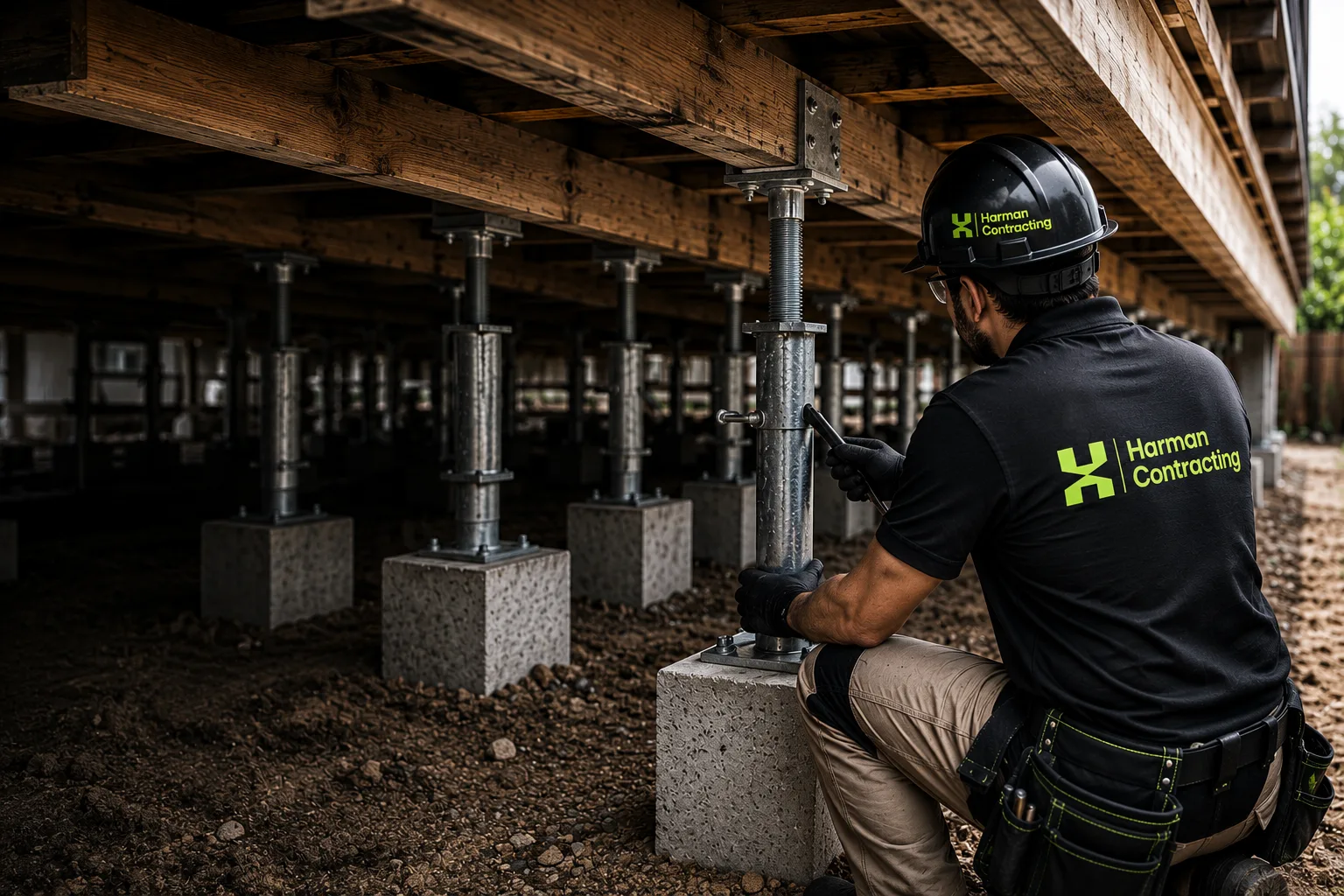
Reblocking & Restumping – For the smaller proportion of Mulgrave properties on timber subfloor construction, we replace deteriorated stumps and relevel floors.
Pre-Purchase Foundation Assessment – Mulgrave’s older 1960s–70s homes warrant a proper foundation assessment before purchase. We give buyers a clear, honest picture of what they’re committing to before contracts are exchanged.
Pre-Construction Foundation Condition Documentation – For established property owners adjacent to planned demolition or development, we document your foundation’s condition before neighbouring works begin.
Crack Assessment & Repair – We identify whether cracking is cosmetic or structural, what’s driving it at ground level, and carry out repairs once the underlying cause is properly understood and addressed.
Foundation Repair Connected to Drainage Issues – Where slab movement is connected to drainage problems — blocked or broken stormwater infrastructure, or drainage concentrated against a footing — we address the structural repair alongside the drainage cause.